How to keep makhana crisp after opening
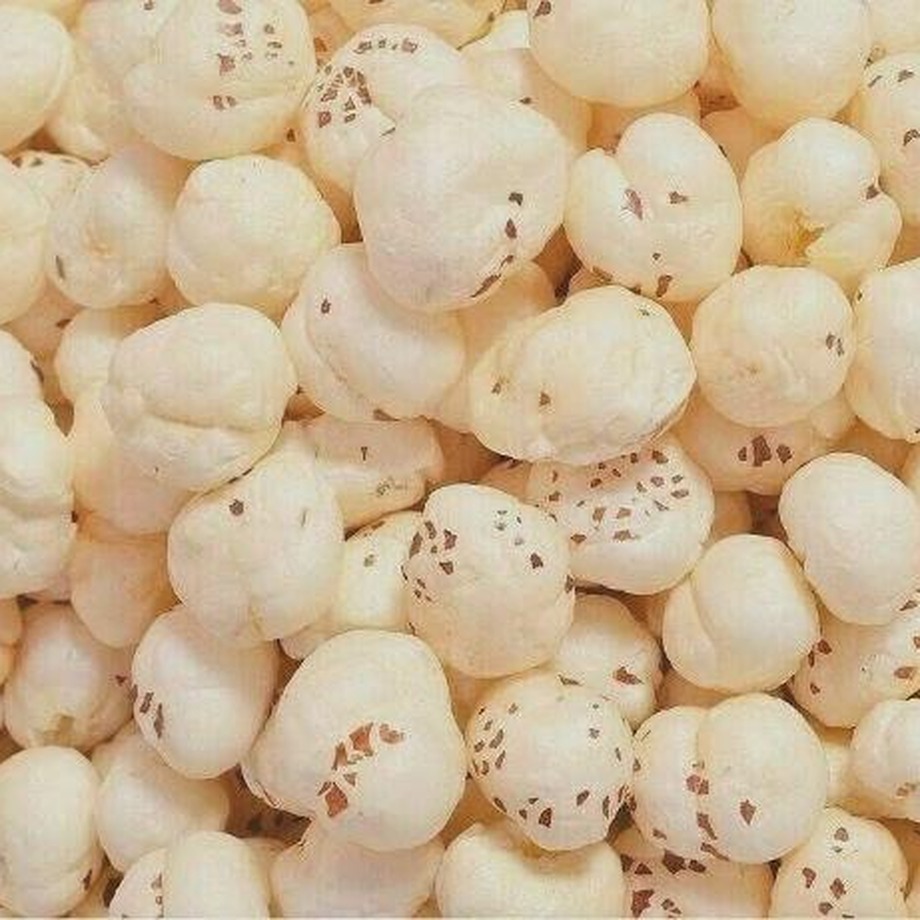
Makhana stays crisp when it is kept away from air, moisture and strong kitchen smells. After opening a pack, move it to a clean, completely dry, airtight container, close it quickly after each use, and store it in a cool, dry cupboard.
If it has turned slightly soft, you can usually bring back the crunch by dry-roasting it gently for a few minutes and letting it cool fully before storing again. The key is not just heating it, but cooling it in open air and then sealing it only after it is completely cool.
Why makhana loses crispness after opening
Plain makhana is light, airy and porous. That is why it feels crisp when you bite it — but the same airy structure also makes it sensitive to moisture in the air.
Food texture research explains that crisp snacks lose their brittle bite when they absorb moisture. In starch-based crispy foods, water acts like a softening agent: it changes a brittle, glassy texture into a softer, rubbery one. Makhana is not the same as a packaged chip, but the practical lesson is similar: keep it dry if you want it crisp.
A study on popped makhana also found that popping changes makhana into a highly porous structure and increases its water absorption capacity. In everyday kitchen terms, opened makhana can pick up dampness faster than a dense grain or nut, especially during monsoon weather, winter fog, or in kitchens where steam from cooking is common.
That is why “just clipping the packet” is often not enough after opening. A clip may reduce spills, but it may not protect the makhana properly from humidity.
Illustration
The best container after opening
Use a container that is:
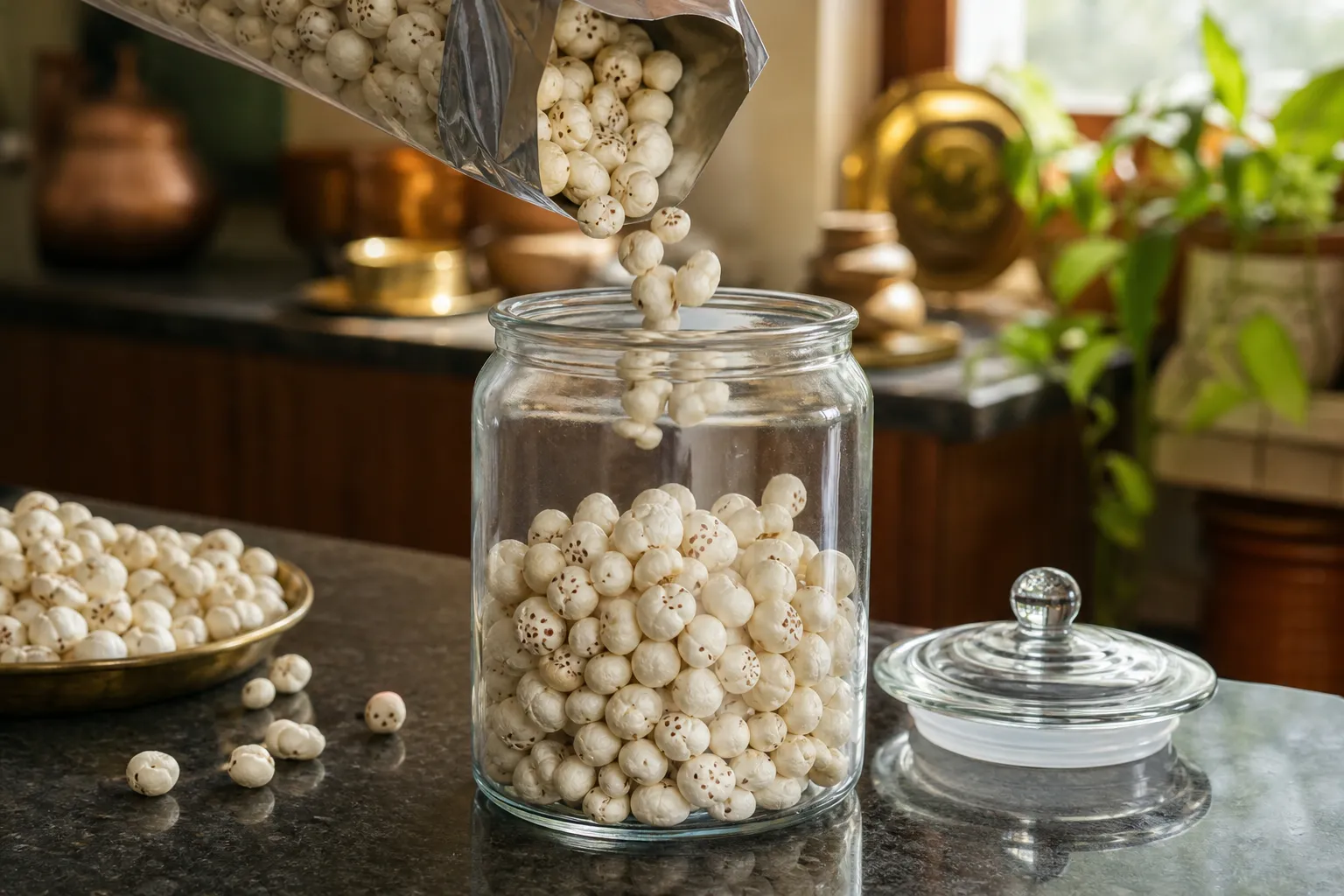
- Airtight: A tight lid matters more than the material.
- Clean and odour-free: Makhana can pick up smells from masalas, pickles or fried snacks.
- Completely dry: Even a few drops of water in a jar can soften the whole batch.
- Easy to open and close quickly: The longer the lid stays open, the more humid air enters.
Glass jars, steel dabbas with tight lids, or good-quality food-grade plastic containers all work. If the original pouch has a strong resealable closure, you can keep makhana in the pouch and then place that pouch inside a second airtight dabba. This double layer helps if your kitchen is humid.
FSSAI’s home food guidance for cereals and pulses says storage containers should be clean, and the storage place should be dry and free from moisture. That advice fits makhana well because crispness depends so much on dryness.
Where to keep it in the kitchen
Choose a place that is cool, dry and away from steam. A closed pantry shelf or upper kitchen cabinet is better than a spot near the stove, sink, pressure cooker or kettle.
Avoid these places:
- Near the gas stove or induction cooktop
- Next to the sink or water filter
- Above a kettle, rice cooker or steamer
- Inside a fridge, unless the pack is sealed extremely well
- In a container that recently held achar, masala, coffee or strongly flavoured snacks
Refrigeration is not usually needed for plain makhana. In many homes, the fridge can add a condensation risk: when a cold container is opened in warm air, moisture can settle on the food or inside the container. If you must store it in a fridge because of local conditions, seal it very well and allow the closed container to come closer to room temperature before opening.
How to store a large pack smartly
If you buy a larger pack, do not open the whole quantity again and again. Divide it once.
Here is an easy method:
- Keep one small jar for daily use.
- Keep the remaining makhana in a larger airtight container.
- Open the large container only when refilling the small jar.
- Use a clean, dry spoon or dry hands.
- Close both containers immediately.
This habit reduces the number of times the main stock meets humid air. It also helps for Diwali snacking and gifting prep; Diwali falls on 8 November in 2026, and many homes start planning dry snacks and kheer ingredients in advance.
If you are checking quality before buying your next pack, you may also like our guide on /blog/how-to-spot-good-makhana. Good storage helps, but good storage cannot fix a pack that already had too many broken, damp or uneven pieces.
How to re-crisp makhana on the stove
If your makhana is only slightly soft, dry-roasting is the simplest fix.
Stove method
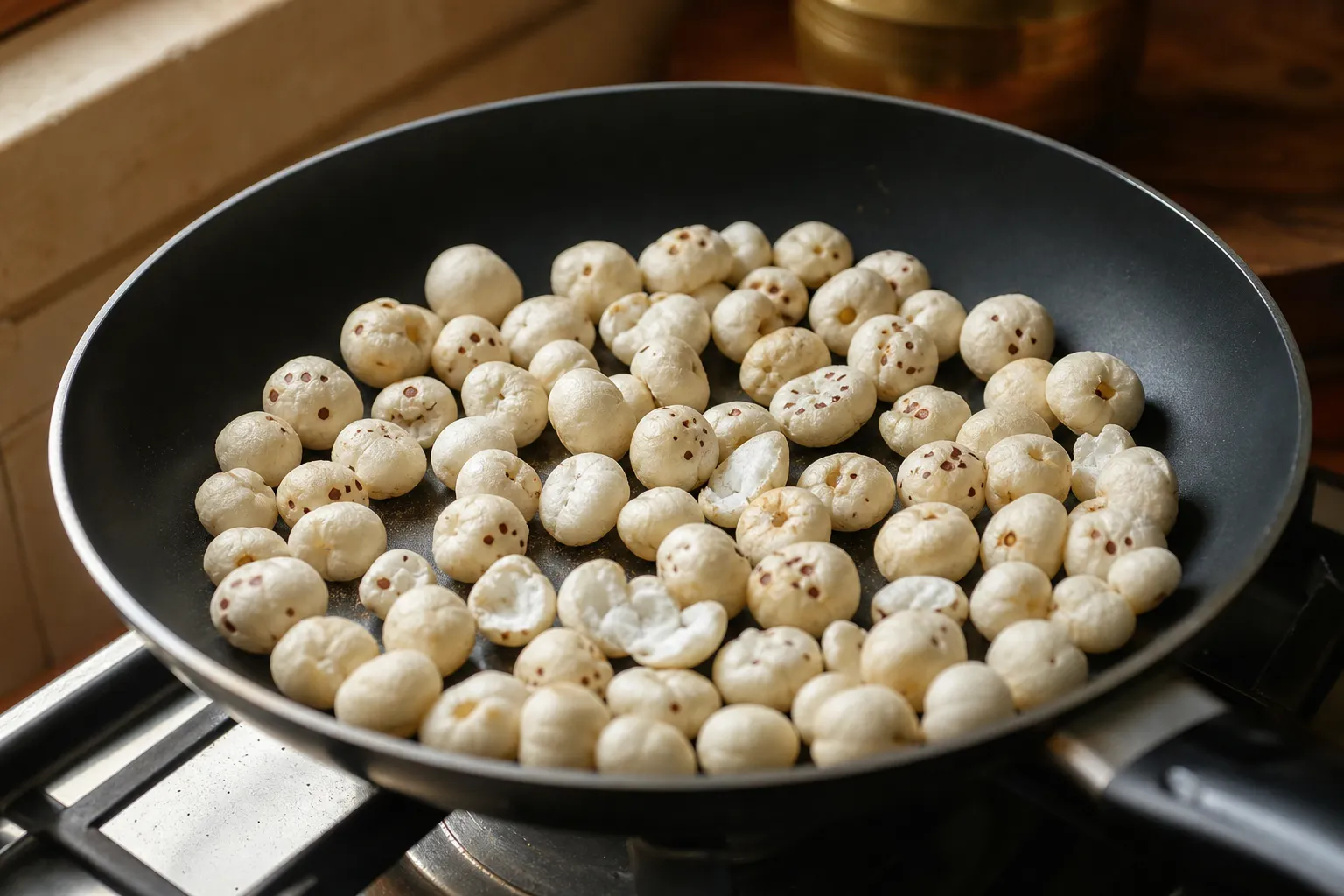
- Heat a thick-bottomed kadhai or pan on low flame.
- Add the makhana without oil or ghee if you only want to restore crispness.
- Stir continuously for 3–5 minutes.
- Break one piece or bite it carefully after it cools for a few seconds.
- Once crisp, spread the makhana on a plate.
- Let it cool completely.
- Store it in an airtight container.
Do not seal it while warm. Warm makhana can release trapped heat and moisture into the container, and that can make it soft again.
If you want masala makhana, re-crisp first, then add ghee or oil and seasoning at the end. Plain makhana should be crisp before flavouring; otherwise the masala may stick unevenly and the texture may stay chewy.
How to re-crisp makhana in an oven or air fryer
For a bigger quantity, an oven or air fryer can be easier because the heat surrounds the makhana more evenly.
Oven method
Spread makhana in a single layer on a baking tray. Heat at a low to moderate temperature, check after a few minutes, shake the tray once, and remove when crisp. Let it cool fully before storing.
Air fryer method
Put makhana in the basket in a loose layer. Use a low to moderate temperature and shake once in between. Check early because makhana is light and can brown faster than expected.
The exact time depends on the appliance, quantity and how soft the makhana is. Start with a shorter time and add more only if needed. A light, dry crunch is the goal; browning is not necessary for storage.
Illustration
What not to do
Do not store with warm roasted makhana
If you roast makhana at home, let it cool completely before putting it away. This is one of the most common reasons a fresh batch turns soft by the next day.
Do not use a wet spoon
A wet spoon can introduce enough moisture to spoil the texture of the top layer and then slowly affect the rest.
Do not mix old and fresh batches casually
If an old batch has turned soft, re-crisp it separately. Do not mix it into a fresh crisp batch until it has cooled and passed the crunch test.
Do not leave the jar open during cooking
Steam from dal, rice, tea or sabzi can enter quickly. Take what you need, close the lid, and then continue cooking.
How to store makhana for kheer, vrat and cooking
For kheer, curry or sabzi, the makhana does not need to stay as crunchy until the final bite because it will be cooked in liquid. Still, dry storage matters. Damp makhana can smell flat and may roast unevenly before cooking.
For vrat recipes, it is especially useful to keep a separate, clearly labelled jar. If your home keeps vrat ingredients separate from regular masala items, store makhana in its own clean container away from everyday spice mixes. For recipe ideas, see /blog/makhana-for-vrat.
For everyday cooking, a small jar near your prep area is convenient, while the main stock can stay sealed in the pantry.
How long does opened makhana stay crisp?
There is no single answer because it depends on humidity, container quality and how often you open the jar. In a dry kitchen, makhana can stay crisp for longer. In a humid kitchen, it can soften quickly if the lid is loose or the jar is opened often.
Instead of relying only on days, use three checks:
- Sound: Crisp makhana makes a clear crackle when broken.
- Feel: It should feel dry and light, not leathery.
- Smell: It should smell clean and neutral, not musty or stale.
If you notice mustiness, visible moisture, insects, unusual colour, or an unpleasant smell, do not try to rescue it by roasting. Re-crisping is for texture loss, not for making unsafe food safe.
A simple daily routine
Here is the easiest routine for most homes:
Open the pack, transfer the makhana to a dry airtight jar, keep a smaller daily-use jar if needed, and close the lid right after every use. If it softens slightly, dry-roast on low flame, cool completely, and seal again.
Kashvee Naturals plain makhana is single-ingredient phool makhana: white popped kernels with nothing added and no added preservatives. It is hand-graded by size, with no broken or small pieces packed. Choose Jumbo Makhana when you want larger pops for snacking, kheer or gifting, and Classic Makhana for everyday cooking and regular pantry use.
Sources
- Eat Right Handbook — Food Safety and Standards Authority of India
- Guidance Document: Food Safety Management System for Catering Sector — Food Safety and Standards Authority of India
- Effect of popping on physicochemical, technological, antioxidant, and microstructural properties of makhana seed — Journal of Food Processing and Preservation
- Effect of powdering on critical water activity estimate from dynamic dewpoint isotherm of a crispy starch-based snack — Journal of Food Science and Technology
- Crispness: a critical review on sensory and material science approaches — Trends in Food Science & Technology
- Diwali 2026 date — Drik Panchang